March 14, 2026 08:04 am (IST)
Follow us:
facebook-white sharing button
twitter-white sharing button
instagram-white sharing button
youtube-white sharing button
'Nobody will hire them': Supreme Court says menstrual leave would backfire, hurt women's careers | Rupee sinks to record low as West Asia conflict shakes Indian markets | ₹20 lakh crore wiped out: Indian markets post worst week in 4 years amid West Asia tensions | America’s flip-flop on Russian oil: How Washington sends conflicting signals to India | Big diplomatic win! Iran allows Indian oil tankers through the Strait of Hormuz | ‘It was over in the first hour’: Trump declares victory in Iran war, says ‘nothing left to target’ | Indian-origin shopkeepers face targeted attacks in Wembley; Somali men suspected | Iran pulls out of 2026 FIFA World Cup amid war with US-Israel | Supreme Court allows first-ever passive euthanasia for 32-year-old man in coma for 13 years | As Iran-US war disrupts global gas supply, India issues guidelines to manage shortages

"PM Modi should discuss alternative methods to get Turkmenistan natural gas"

| | Jul 07, 2015, at 04:46 pm
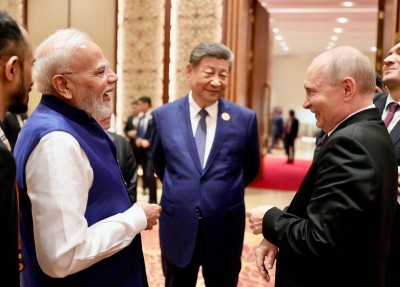
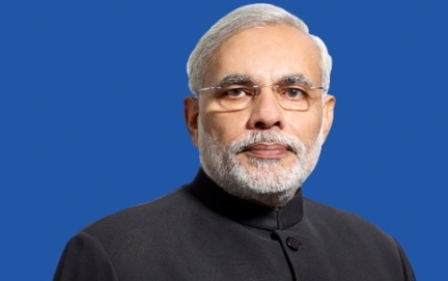
On 6 July 2015, Prime Minister Modi commenced his visit to five Central Asian republics. His tour has begun with visits to Uzbekistan and Kazakhstan, after which he will attend the BRICS and SCO summits in Russia. Following the summit, he will continue his tour to Turkmenistan, Kyrgyzstan and Tajikistan. Energy security will be the key theme for his visits.

India is scaling-up its nuclear power projects, even as countries such as Japan and Germany have shut down, or are preparing to shut down, nuclear power plants. India aims to increase its share of electricity generated through nuclear energy from 3.5% to 25% by 2050, but it has insufficient reserves of uranium. It requires stable supplies of the fuel from countries such as Kazakhstan, Uzbekistan and Russia, with whom it has signed deals for supplying uranium.

Pipeline agreements, on the other hand, are more complex. The Turkmenistan-Afghanistan-Pakistan-India (TAPI) gas pipeline project, which was expected to bring natural gas from Turkmenistan to Afghanistan, Pakistan and India, has stalled due to India-Pakistan border disputes. Until these disputes are resolved, it is unlikely that the TAPI pipeline project will materialise.

It is necessary for Prime Minister Modi to discuss alternative methods for India to receive natural gas from Turkemenistan. Bringing Turkmenistan’s gas to a port through a pipeline via Iran and then shipping it to India as LNG is only possible when economic sanctions on Iran are lifted. 

 
However, this will be a more expensive route because in addition to setting up pipelines, investments will also be needed to set up LNG terminals and for shipping. Such a project would be counterproductive for Iran – it has the world’s second largest gas reserves and can emerge as a major supplier if sanctions are lifted. Iran’s gas reserves are located in more accessible regions and will likely get to the market before gas from Turkmenistan.

On the renewable energy front, Tajikistan and Kyrgyzstan have significant hydropower potential but insufficient local demand. India can benefit from hydropower imports from these two countries, using a model similar to its partnership with Bhutan – funding hydropower projects and then buying the electricity. 
 
However, India does not have a physical border with either Tajikistan or Kyrgyzstan and so power will require transit via Pakistan, putting such a project in the same predicament as TAPI.”

(Amit Bhandari is a fellow for energy and environment studies at foreign policy think tank group Gateway House: Indian Council on Global Relations)

Support Our Journalism

We cannot do without you.. your contribution supports unbiased journalism

IBNS is not driven by any ism- not wokeism, not racism, not skewed secularism, not hyper right-wing or left liberal ideals, nor by any hardline religious beliefs or hyper nationalism. We want to serve you good old objective news, as they are. We do not judge or preach. We let people decide for themselves. We only try to present factual and well-sourced news.

Support objective journalism for a small contribution.