 Crude Oil
Two oil tankers break Strait of Hormuz deadlock, reach India amid West Asia conflict
Mumbai/IBNS: Two crude oil tankers carrying nearly three million barrels of West Asian crude have reached India after successfully navigating the conflict-hit Strait of Hormuz, offering a rare sign of movement in a maritime corridor that has witnessed severe disruption since the latest escalation in the Middle East.
Shipping data and industry sources confirmed that the vessels arrived in India after passing through the strategic waterway linking the Persian Gulf with the Arabian Sea.
Their arrival has fuelled hope within India’s energy sector that additional shipments of oil and liquefied petroleum gas currently stranded in the Gulf region may soon reach Indian ports.
Tankers carrying Saudi and Iraqi crude reach Mumbai
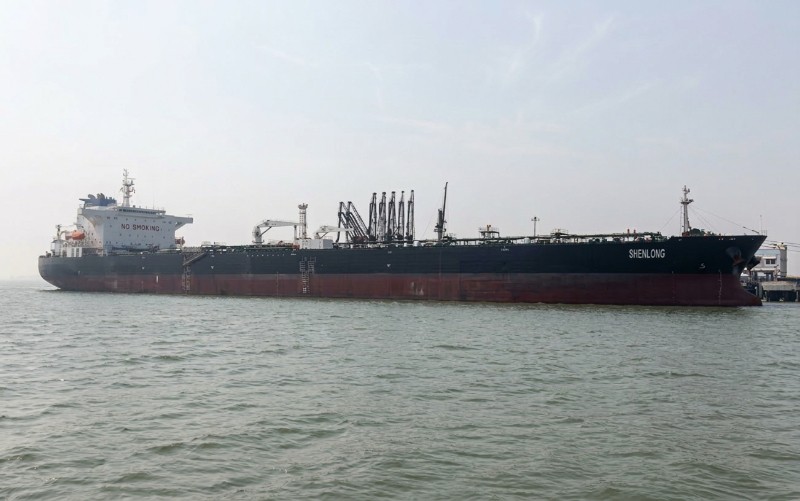
One of the vessels, the Liberia-flagged Suezmax tanker Shenlong, delivered roughly one million barrels of Saudi crude oil to Mumbai Port on Wednesday, according to maritime tracking data.
Another tanker, an India-flagged very large crude carrier carrying approximately two million barrels of Iraqi crude, also reached Mumbai and is scheduled to sail onward to Paradip for further discharge.
Industry sources indicated that both vessels had likely crossed the Strait of Hormuz within the past five to six days.
The arrival marks one of the first known instances of non-Iranian crude carriers transiting the strait since hostilities escalated in the region in late February.
Diplomatic engagement over shipping safety
Officials said India has engaged with Tehran to ensure the safe passage of vessels carrying energy supplies to the country.
Several oil and liquefied petroleum gas tankers are currently positioned west of the Strait of Hormuz, awaiting safe transit.
According to Randhir Jaiswal, spokesperson for the Ministry of External Affairs, the issue has featured prominently in recent diplomatic exchanges.
He noted that S. Jaishankar held multiple discussions with his Iranian counterpart in recent days, during which the safety of maritime shipping and India’s energy security were addressed.
While details of these discussions remain undisclosed, officials suggested that efforts are ongoing to facilitate uninterrupted energy shipments.
A Liberian-flagged tanker #Ship #Shenlong, carrying #CrudeOil, docked at #MumbaiPort.
— Surya Reddy (@jsuryareddy) March 12, 2026
It's the first India-bound vessel to safely navigate the Strait of Hormuz since the West Asia conflict.
The vessel captained by an Indian, was carrying crude oil loaded from Ras Tanura Port,… pic.twitter.com/2eyqHnwtAt
Tanker used ‘dark mode’ to avoid detection
Maritime tracking data revealed that the Shenlong temporarily switched off its Automatic Identification System while crossing the strait, a practice commonly referred to as “going dark”.
The AIS normally broadcasts a ship’s identity, location, speed and direction to other vessels and monitoring agencies.
International maritime regulations generally require it to remain active, but ships sometimes deactivate it temporarily in high-risk zones to avoid detection or targeting.
Tracking records showed the tanker’s last signal inside the Strait of Hormuz on March 8 before it disappeared from monitoring systems.
The vessel reappeared on global tracking networks a day later after safely exiting the narrow waterway and later berthed at Mumbai.
Officials at Mumbai Port Authority confirmed that the tanker carried about 135,000 metric tonnes of crude oil and began unloading its cargo at Jawahar Dweep Terminal shortly after arrival.
Strategic waterway under severe pressure
The Strait of Hormuz remains one of the world’s most critical energy chokepoints.
The narrow channel between Iran and Oman handles nearly one-fifth of global liquid petroleum consumption as well as a significant share of the world’s liquefied natural gas trade.
Since the outbreak of the latest regional conflict, maritime traffic through the strait has slowed dramatically.
Thailand protests Iran attack on Thai ship
— Ali Hamza (@hamzitron) March 12, 2026
Oman rescued 20 crew members out of 23, 3 are still missing.
Thailand calling this strike a “serious breach of international law.” pic.twitter.com/2QOGJZaqBj
Reports indicate that Iran has allowed primarily its own oil tankers—mostly bound for China—to pass through while other vessels faced severe risks.
Several ships have been attacked or damaged during transit.
A Thai bulk carrier travelling from the United Arab Emirates toward India reportedly caught fire after being struck by projectiles while crossing the strait.
Rescue operations recovered most of the crew, although some seafarers remain missing.
#BREAKING
— Maitre Hiruzen 🐘 🇨🇮 (@Famouss26) March 12, 2026
The moment that Iran’s IRGC Navy targeted the US Safe Sia ship in the northern Persian Gulf https://t.co/r8uao4Osag pic.twitter.com/RXdsF4kred
Implications for India’s energy security
The disruption carries serious implications for India, which relies heavily on crude imports from the Gulf.
In recent months, roughly 2.5 to 2.7 million barrels per day of India’s oil imports—nearly half of the country’s total supply—have travelled through the Strait of Hormuz.
These imports primarily originate from Iraq, Saudi Arabia, the United Arab Emirates and Kuwait. India currently does not purchase Iranian crude due to sanctions imposed by the United States.
While India maintains reserves equivalent to roughly eight weeks of crude oil, petrol and diesel consumption, the situation is more fragile when it comes to liquefied petroleum gas.
India imports nearly 60 percent of its LPG requirements, and about 90 percent of those supplies usually pass through the Strait of Hormuz.
With a large portion of LPG shipments temporarily stalled due to the conflict, authorities have prioritised household consumption, diverting supplies away from industrial and commercial users.
Industry observers say that if additional oil and LPG cargoes currently waiting in the Persian Gulf manage to reach Indian ports in the coming days, it could significantly ease supply concerns and stabilise energy logistics across the country.
Support Our Journalism
We cannot do without you.. your contribution supports unbiased journalism
IBNS is not driven by any ism- not wokeism, not racism, not skewed secularism, not hyper right-wing or left liberal ideals, nor by any hardline religious beliefs or hyper nationalism. We want to serve you good old objective news, as they are. We do not judge or preach. We let people decide for themselves. We only try to present factual and well-sourced news.
Support objective journalism for a small contribution.