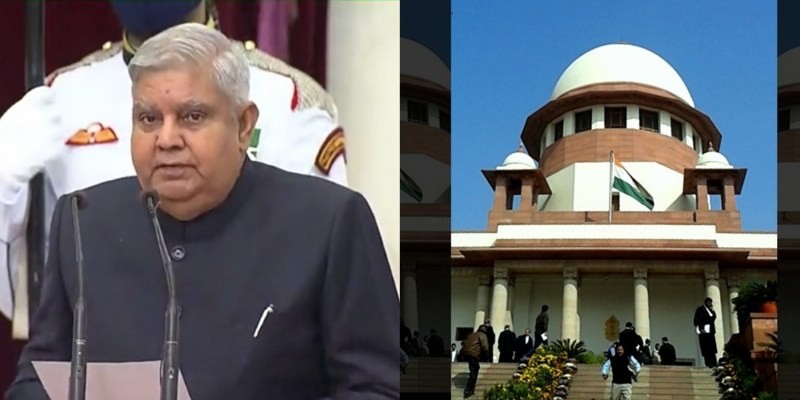
VP Jagdeep Dhankhar slams SC order on President’s role in state bills
New Delhi: Vice President Jagdeep Dhankhar has sharply criticised a recent Supreme Court directive that requires the President to act within a set timeframe on bills forwarded by governors, media reports said.
Describing it as a troubling development, he argued that the judiciary was never meant to function as lawmakers, the executive, or as a "super Parliament".
“There is a directive to the President by a recent judgement. Where are we heading? What is happening in the country?” he asked while addressing Rajya Sabha interns, according to a report in the media.
Last week, the Supreme Court ruled that when a governor reserves a bill for the President under Article 201 of the Constitution, a decision must be made within three months.
The verdict, delivered in a case concerning the Tamil Nadu Governor’s prolonged inaction on state bills, emphasised that the President does not possess a “pocket veto” and must respond—either by giving or withholding assent—within a reasonable time.
Calling the judgement “unprecedented”, Dhankhar said, “We never bargained for democracy for this day. President being called upon to decide in a time-bound manner, and if not, becomes law.”
He cautioned against what he sees as judicial encroachment into the domains of the legislature and executive.
“So we have judges who will legislate, who will perform executive functions, who will act as super Parliament, and absolutely have no accountability because law of the land does not apply to them,” he said.
Dhankhar further flagged the erosion of constitutional separation of powers and invoked the President's oath—“to preserve, protect and defend the Constitution”—which, he said, sets the office apart from others who only swear to “abide by the Constitution.”
“We cannot have a situation where you direct the President of India and on what basis?” he questioned.
Citing constitutional provisions, he argued that the judiciary’s role in such matters is limited to interpreting the Constitution under Article 145(3), and even that requires a bench of five or more judges.
What the Supreme Court said:
In its verdict on the Tamil Nadu government's plea against the Governor’s delay, the top court held that constitutional authorities must act within a reasonable timeframe, even when the law does not lay down a specific deadline.
“The position of law is settled that even where no time-limit is prescribed for the exercise of any power under a statute, it should be exercised within a reasonable time,” the bench, comprising Justices JB Pardiwala and R Mahadevan, noted, according to the report.
The court also asserted that delays in the President’s response to such bills are subject to judicial review.
If no action is taken within three months, valid reasons must be documented and communicated to the concerned state.
The judgement further clarified that questions around a bill’s constitutional validity fall solely within the jurisdiction of constitutional courts.
“Only the constitutional courts have the prerogative to study and provide recommendations,” it stated.
Support Our Journalism
We cannot do without you.. your contribution supports unbiased journalism
IBNS is not driven by any ism- not wokeism, not racism, not skewed secularism, not hyper right-wing or left liberal ideals, nor by any hardline religious beliefs or hyper nationalism. We want to serve you good old objective news, as they are. We do not judge or preach. We let people decide for themselves. We only try to present factual and well-sourced news.
Support objective journalism for a small contribution.