


At UN debate, Japan vows to back global push for inclusive quality education for all girls and women
New York: If women were able to demonstrate their potential, “the world would sparkle that much more”, the Prime Minister of Japan said on Tuesday evening at the United Nations General Assembly’s annual general debate.
“In Japan, where the labour participation rate for women has seen a marked rise, we are witnessing that self-evident fact on a daily basis”, said Shinzo Abe.
He recalled that last March, while Malala Yousafzai was in Tokyo, she told him that perhaps 100 million girls lack the skills they need to have a good command of modern technology, because they don't undergo a minimum education of 12 years.
Highlighting policies that empower women and girls, Mr. Abe was delighted that his country has been “able to capture what Malala advocates for”.
“We pledged to ‘promote inclusive quality education for all girls and women’ [and] Japan wishes to run at all times at the very front of the pack with respect to these efforts”, he said.
Over the next three years, Japan will provide “enriched education to a minimum of nine million children and young people in Sub-Saharan African and Asian nations”, with a plan to “expand e-learning for primary school children” in Sri Lanka and “Internet-based mathematics and science education” in Rwanda, according to the Prime Minister.
Noting that this was his seventh address to the General Assembly, he flagged that over that time, “I have consistently emphasized the importance of empowering women and girls and the value of making health care universally available”.
At the same time, he emphasized that Japan “earnestly” values education and “aspires to be an ‘FP’…or a ‘foster power, one that fosters human capacity”.
Three points
In closing Abe made three distinct points, beginning with North Korea.
Advocating for an approach by which two leaders “talk candidly with each other and try to work out the issues at hand”, the Prime Minister asserted: “I am determined to meet Chairman Kim Jong-un myself face to face, without attaching any conditions”.
“Japan’s unchanging objective is to normalize its relations with North Korea through comprehensively resolving the outstanding issues of concern with North Korea, including the abductions, nuclear, and missile issues, as well as settling the unfortunate past”, he said.
Secondly, he expressed Japan’s concerns regarding the situation in the Middle East.
“The attack on Saudi Arabia’s crude oil facilities was an extremely contemptible crime that holds the international economic order hostage”, Mr. Abe said.
“I consider precious the pronouncement made to me directly by Supreme Leader Khamenei of Iran, that he issued as a fatwa three repudiations regarding nuclear weapons, namely ‘not to possess, produce, or use’ them, and has ensured thorough implementation of that fatwa”.
Point number three was Japan’s intention to use multilateral frameworks and globalism to reduce disparities.
“The world will become more connected, leading more people to escape from poverty”, he maintained.
The Prime Minister argued that the world has the ability to make the changes it needs, and that “shall be reaffirmed right here in this great assembly hall”.
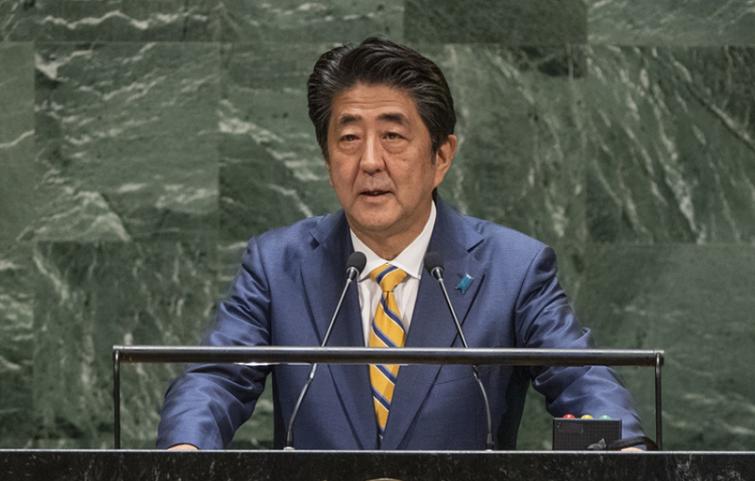
Photo caption and credit:
UN Photo/Cia Pak
Shinzo Abe, the Prime Minister of Japan, addresses the 74th session of the UN General Assembly
Support Our Journalism
We cannot do without you.. your contribution supports unbiased journalism
IBNS is not driven by any ism- not wokeism, not racism, not skewed secularism, not hyper right-wing or left liberal ideals, nor by any hardline religious beliefs or hyper nationalism. We want to serve you good old objective news, as they are. We do not judge or preach. We let people decide for themselves. We only try to present factual and well-sourced news.
Support objective journalism for a small contribution.


