

 India-New Zealand
India–New Zealand Free Trade Agreement Takes Effect
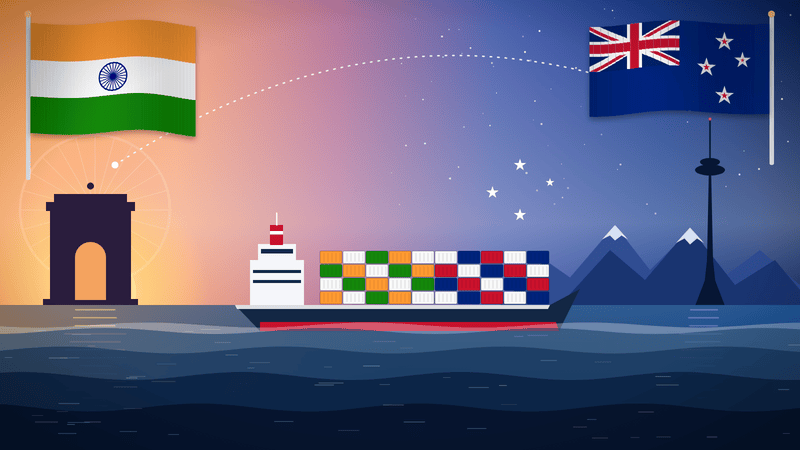
New Delhi: India and New Zealand's free trade agreement took effect on Tuesday, giving Indian goods duty-free entry to New Zealand and opening much of India's market to Kiwi exporters.
The pact was negotiated in about nine months, a speed that India's Commerce Ministry has described as among the fastest for any of its trade deals.
It brings New Zealand's sheepmeat, wool, coal and most forestry exports into India without tariffs from the first day.
In return, New Zealand has removed duties on every tariff line for Indian exports and offered Indian workers and students new visa routes.
Background
New Zealand has long sought a way into the Indian market, where it faced some of the highest tariffs on its farm and wine exports.
India, for its part, has been signing trade deals with developed economies to diversify its export markets.
Commerce Minister Piyush Goyal and New Zealand's Trade and Investment Minister Todd McClay launched negotiations in March 2025.
The two sides held five formal rounds, in New Delhi, Queenstown and Auckland, before announcing the substantive conclusion of talks on Dec. 22, 2025, according to India's Press Information Bureau and New Zealand's Ministry of Foreign Affairs and Trade.
The agreement was signed on April 27, 2026, at Bharat Mandapam in New Delhi.
New Zealand's government said both countries completed their domestic procedures on Sept. 21, when McClay and India's High Commissioner, Muanpuii Saiawi, exchanged documents in Parliament.
At the signing, Goyal called the agreement "a defining milestone in India's engagement with the developed world." McClay called it a "once-in-a-generation" opportunity.
What India gets
New Zealand has opened all of its tariff lines to Indian exports.
The Indian government said the change helps labour-intensive sectors such as textiles, apparel, leather and footwear, as well as marine products, handicrafts, engineering goods and automobiles.
New Zealand had charged duties of up to 10 per cent on items such as ceramics, carpets, cars and auto parts.
Indian manufacturers also get duty-free access to wooden logs, coking coal, and metal waste and scrap.
The mobility provisions are among the deal's most closely watched features.
A Temporary Employment Entry visa allows up to 5,000 workers at any one time to stay for up to three years.
It covers IT, engineering, healthcare, education and construction workers as well as yoga instructors, AYUSH practitioners, chefs and music teachers.
A working holiday visa is open to 1,000 young Indians a year.
Indian students get the right to work at least 20 hours a week.
They also get post-study work rights of up to three years for STEM graduates and four years for doctoral graduates, with no numerical cap.
New Zealand has also made services commitments in about 118 sectors and pledged to facilitate $20 billion of investment into India over 15 years, according to the Commerce Ministry.
The word "facilitate" matters: the figure is a target for investment flows, not a sum the New Zealand government will itself spend.
What New Zealand gets
India will cut or remove duties on about 70 per cent of its tariff lines, covering 95 per cent of bilateral trade by value, according to the PIB.
New Zealand's government said 57 per cent of its exports to India enter duty-free on day one, including sheepmeat, wool and coal, along with more than 95 per cent of forestry and wood exports.
A second round of tariff cuts follows on January 1, 2027.
Other gains phase in or come with quotas.
Wine tariffs fall from 150 per cent to 25 or 50 per cent over 10 years and kiwifruit gets duty-free entry within a quota that starts at 6,250 tonnes and rises to 15,000 tonnes.
Apples have a quota of 32,500 tonnes, rising to 45,000 tonnes, at a 25 per cent duty.
Mānuka honey tariffs fall from 66 per cent to 16.5 per cent over five years, and seafood becomes duty-free over seven years.
Prime Minister Christopher Luxon has said the deal opens "doors of opportunity" to 1.4 billion people and supports New Zealand's aim of doubling its export value within a decade.
Where the pact is contested
India kept its most politically sensitive products out. Dairy, sugar, edible oils, coffee, spices and several other agricultural goods are excluded, according to the PIB.
New Zealand's government says some dairy still benefits, with ingredients for re-export entering duty-free and a quota for high-value milk albumins at half the tariff.
The apple quota drew criticism in India soon after signing. Congress MLA Kuldeep Singh Rathore said imports during the April–August window would put pressure on prices and hurt orchard owners in Himachal Pradesh, where yields are far below New Zealand's.
He asked the Centre to enforce strict quota monitoring and the minimum import price of $1.25 a kg.
The government's published terms include both safeguards, along with a seasonal window.
In New Zealand, coalition partner New Zealand First opposed the deal in April.
Its leader, Winston Peters, called it "neither free nor fair," pointing to the limited dairy access and the 5,000-visa pathway.
The agreement has since cleared New Zealand's domestic process, though the political argument over migration and dairy has not gone away.
Support Our Journalism
We cannot do without you.. your contribution supports unbiased journalism
IBNS is not driven by any ism- not wokeism, not racism, not skewed secularism, not hyper right-wing or left liberal ideals, nor by any hardline religious beliefs or hyper nationalism. We want to serve you good old objective news, as they are. We do not judge or preach. We let people decide for themselves. We only try to present factual and well-sourced news.
Support objective journalism for a small contribution.