


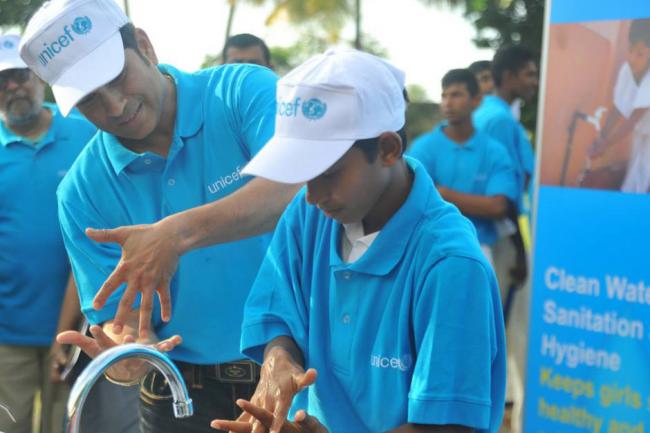
Handwashing Day: UNICEF warns inadequate hygiene endangers development goal
“Along with drinking water and access to toilets, hygiene – particularly handwashing with soap – is the essential third leg of the stool holding up the [Sustainable Development] Goal on water and sanitation,” said Sanjay Wijesekera, global head of UNICEF’s water, sanitation and hygiene programmes, in a press release.
The eighth Global Handwashing Day, marked annually on 15 October, comes less than a month after all 193 Member States of the United Nations adopted the Sustainable Development Goals (SDGs), which includes the target of achieving access to adequate and equitable sanitation and hygiene by 2030.
UNICEF pointed out that it's the first time hygiene is included in the global agenda.
“From birth – when unwashed hands of birth attendants can transmit dangerous pathogens – right through babyhood, school and beyond, handwashing is crucial for a child’s health,” Wijesekera said.” It is one of the cheapest, simplest, most effective health interventions we have.”
Sub-Saharan Africa, the region with the highest child mortality rates globally, has particularly low levels of handwashing. According to UNICEF and the UN World Health Organization (WHO), levels are at best 50 per cent in 38 countries in the region.
Even health care facilities often lack places for handwashing: “Some 42 per cent of them in WHO’s Africa Region have no water source available within 500 metres,” the UNICEF press release underlines.
In addition, UNICEF says improvements in hygiene must supplement access to water and sanitation, or children will continue to fall victim to easily preventable diseases like diarrhoea.
To mark the international day, activities are being organized around the world which aim to teach the importance of handwashing with soap especially to children.
Photo: UNICEF Sri Lanka/Pathum D Magalle
Support Our Journalism
We cannot do without you.. your contribution supports unbiased journalism
IBNS is not driven by any ism- not wokeism, not racism, not skewed secularism, not hyper right-wing or left liberal ideals, nor by any hardline religious beliefs or hyper nationalism. We want to serve you good old objective news, as they are. We do not judge or preach. We let people decide for themselves. We only try to present factual and well-sourced news.
Support objective journalism for a small contribution.


