


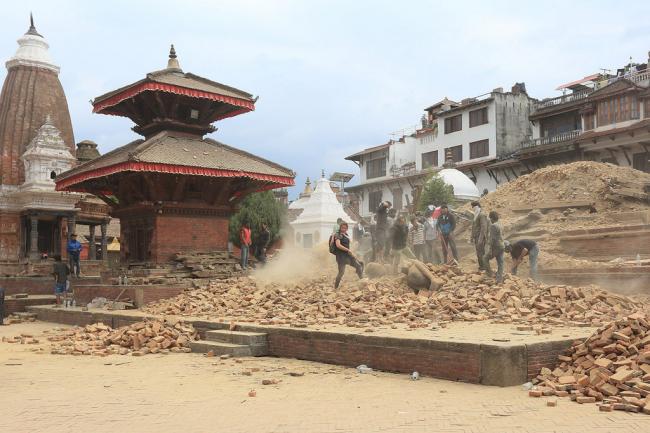
Some 500,000 homes and temples across Nepal damaged by earthquake: UN official
UN Development Programme (UNDP) Assistant Administrator and Director of the Bureau for Policy and Programme Support Magdy Martínez-Solimán told reporters at UN Headquarters that the “good news” is that large infrastructure structures such as the main airport, dams, communications and electricity networks had largely survived the twin earthquakes that hit Nepal.
But Martínez-Solimán, who was briefing on his recent mission to areas of devastation and “daunting challenges” in Nepal in the wake of the 25 April earthquake and its series of powerful aftershocks, said an official assessment of the damage is currently underway and would be ready in early July.
But he described “immense” damage to the 500,000 to 600,000 homes in mostly rural areas, as well as to cultural and historical heritage such as temples, upon which Nepal’s economy depends.
The UNDP official said $175 million is what his agency estimated was needed to reconstruct the homes, which reflected a solid case for “building back better.”
His visit was part of UNDP’s push to hash out a recovery and reconstruction plan for the country that protects and restores infrastructure, services and livelihoods, even as immediate efforts to meet people’s most basic needs continue.
According to the UN Office for the Coordination of Humanitarian Affairs (OCHA), an estimated 2.8 million people are in need of humanitarian assistance with over 860,000 people in immediate need due to loss of shelter, limited road access and poverty.
The total number of casualties now stands at 8,669 with 384 people still missing, OCHA reported.
Meanwhile, a month after the first of the two earthquakes hit Nepal, the UN Children’s Fund (UNICEF) warned some 70,000 children are at risk of malnutrition and require urgent support, including 15,000 children in 14 of the worst-hit districts who need therapeutic foods – like nutrient-rich peanut paste – for the treatment of severe acute malnutrition.
Tomoo Hozumi, UNICEF’s Representative in Nepal, said in a press release issued Monday that the agency is working “double speed with our partners to provide urgent feeding and care to protect the lives of these children and to build their resistance against diseases, especially water-borne diseases, during the upcoming monsoon season.”
The UN Humanitarian Coordinator in Nepal, Jamie McGoldrick, said “substantial progress” to reach the survivors has been made and “considering the conditions and complexities, we are now well-positioned to assist all the affected communities.”
The World Food Programme said nearly 2 million people have received food assistance and a new phase of the response dubbed Operation Mountain Express is now underway to reach people in high-altitude villages.
WFP said it is using trucks, tractors and helicopters to deliver to reach people in need, and teams of mountaineers are reaching villages and assessing needs on behalf of WFP and the wider humanitarian response.
“Up to 20,000 local porters will soon begin bringing aid to these communities,” according to the food agency. “This also gives employment to porters who were out of work because of the drop in tourism.”
The coming monsoon season in Nepal is adding further urgency to relief operations because heavy rains expected from June will curtail access to remote rural areas.
Photo: UNDP Nepal/Laxmi Prasad Ngakhusi
Support Our Journalism
We cannot do without you.. your contribution supports unbiased journalism
IBNS is not driven by any ism- not wokeism, not racism, not skewed secularism, not hyper right-wing or left liberal ideals, nor by any hardline religious beliefs or hyper nationalism. We want to serve you good old objective news, as they are. We do not judge or preach. We let people decide for themselves. We only try to present factual and well-sourced news.
Support objective journalism for a small contribution.


