


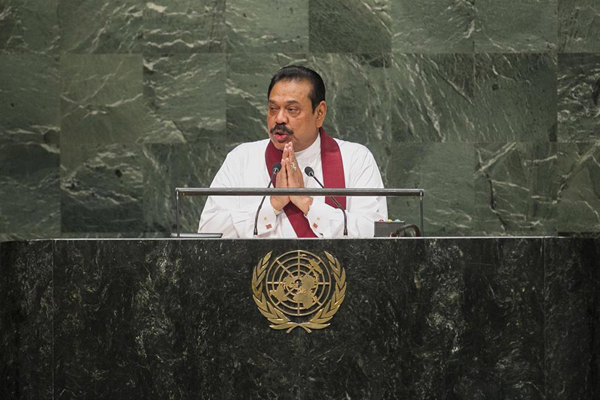
Sri Lanka's President tells UN Assembly post-2015 agenda must address structural obstacles to development
“It is vital that we also address structural obstacles and political barriers that prevented the realisation of the Millennium Development Goals, such as unfair trade and investment rules,” he said.
Consistency of standards is required across the board without any perception of selectivity or discrimination. Human rights must be recognised by all as a moral and ethical concept rather than as a political tool which is sure to have destabilising effects.
“Post-conflict Sri Lanka has also become an unfortunate victim of ill-conceived agenda of some in the Human Rights Council, who pay scant regard to the substantial progress achieved by [the country’s] reconstruction, rehabilitation and reconciliation within a short span of five years,” Rajapaksa said.
He added that for multilateralism to remain relevant, the UN must be de-politicized and stop being held hostage to different forms of funding. Rajapaksa also expressed support for an independent State of Palestine, an end to the financial embargo against Cuba and welcomed partnerships between Asia and Africa.
As a country that has suffered at the hands of terrorism, Sri Lanka looked forward to the early adoption of a UN comprehensive convention on international terrorism to help counter terrorist financing, piracy, and all forms of international organised crime. Rajapaksa also highlighted his country’s achievement of most MDGs with the adoption of a national strategy “Vision for the Future” in areas of agriculture and literacy.
President Mahinda Rajapaksa of Sri Lanka addresses the General Assembly. UN Photo/Hubi Hoffmann
Support Our Journalism
We cannot do without you.. your contribution supports unbiased journalism
IBNS is not driven by any ism- not wokeism, not racism, not skewed secularism, not hyper right-wing or left liberal ideals, nor by any hardline religious beliefs or hyper nationalism. We want to serve you good old objective news, as they are. We do not judge or preach. We let people decide for themselves. We only try to present factual and well-sourced news.
Support objective journalism for a small contribution.


