


 NuclearBan
UN again calls for full ratification of nuclear test-ban treaty
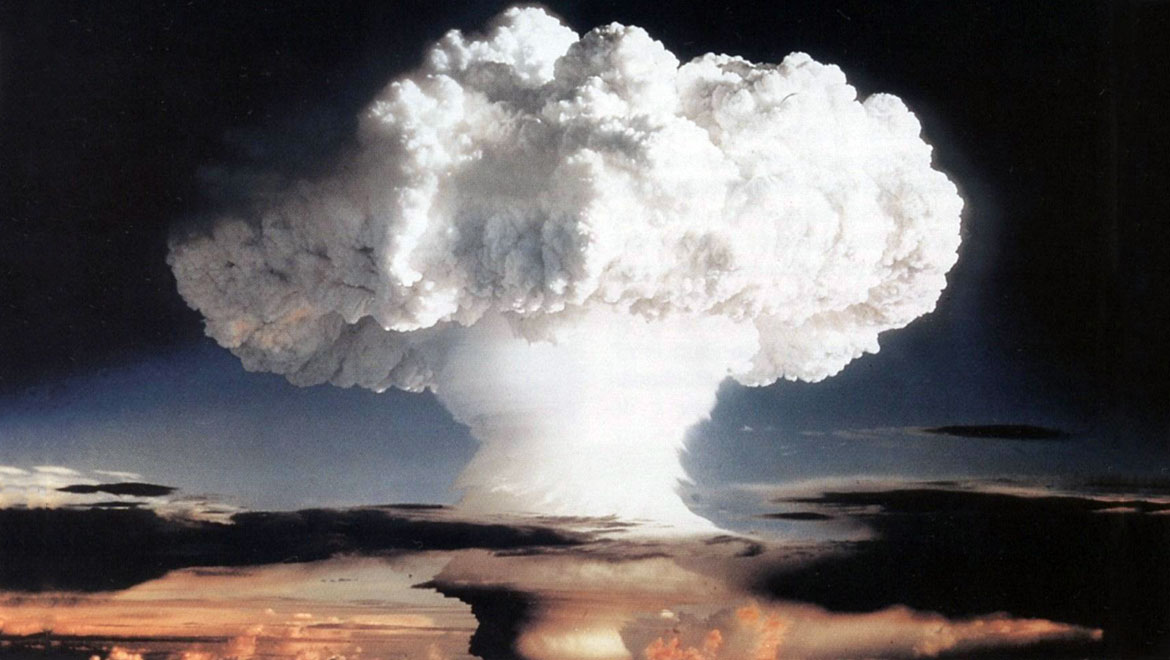
New York: Achieving a nuclear-free world is the best way to honour lives devastated by these weapons, the UN disarmament chief told a virtual meeting held on Wednesday to commemorate the International Day against Nuclear Tests, observed annually on 29 August.
Speaking on behalf of the Secretary-General, Izumi Nakamitsu said this year’s commemoration falls 75 years after the United States first conducted a nuclear test, resulting in the use of atomic weapons against Japan and some 2,000 more tests carried out by at least eight countries over the succeeding decades.
Impacts on the environment, health and economic development are still being felt today.
“The best way to honour the victims of past nuclear tests is to prevent any in the future,” she stated.
“As the Secretary-General has said, nuclear testing is a relic of another era, and should remain there.”
Prioritize a nuclear-free world
The International Day Against Nuclear Tests has been commemorated annually since 2010.
The date 29 August marks the anniversary of the 1991 closure of the Semipalatinsk test site in Kazakhstan, the largest nuclear test site in the former Soviet Union.
Despite the adoption of the Comprehensive Nuclear Test-Ban Treaty in 1996, thousands of nuclear weapons remain at the ready in stockpiles across the world.
As Ms. Nakamitsu, the UN High Representative for Disarmament, pointed out, the current era is marked by “increasingly hostile” relations between nuclear arm states seeking to improve the quality and, in some cases, quantity, of their arsenals.
For UN General Assembly President Tijjani Muhammad-Bande, the COVID-19 pandemic has underscored the need for collective action to safeguard humanity, including by making a nuclear-free world a priority.
“The very survival of humanity hinges on our resolute agreement that nuclear weapons are not to be used and should be forever eliminated. A nuclear weapons-free world is the only true guarantee to safeguard civilization from this existential threat,” he said, speaking from New York.
Impacts on First Nations
Aboriginal people in Wallatina, Australia, experienced this threat first-hand when the United Kingdom conducted two separate atmospheric nuclear tests in October 1953, according to activist Karina Lester.
“Nuclear testing has and still does impact our country, our traditional lands, and our lives,” said Ms. Lester, whose father, the late Yami Lester, was blinded by the tests.
“It’s time to put an end to nuclear weapons tests. It is time to put an end to nuclear weapons.”
‘Nuclear menace on the rise’
Although 184 countries have signed the Comprehensive Nuclear Test-Ban Treaty, and 168 have ratified it, the treaty has yet to enter into force.
This will only happen when it is ratified by eight countries: China, the Democratic People’s Republic of Korea, Egypt, India, Iran, Israel, Pakistan and the United States.
UN Secretary-General António Guterres once again called for all states that have not signed or ratified the treaty to do so without further delay.
“The nuclear menace is once again on the rise. A complete ban on nuclear testing is an essential step in preventing the qualitative and quantitative improvement of nuclear weapons and in achieving nuclear disarmament,” he said in a message for the Day.
Learn from history
With next year marking the 25th anniversary of the test-ban treaty's adoption, the fear is that hope is slipping away, according to Lassina Zerbo, head of the UN office working towards its entry into force.
“As we survey the international landscape, with peoples and governments reeling from the chaos and suffering caused by COVID-19, let us reflect on the past in order to learn how to better shape the future,” he advised.
“This is not to say that the past will give us all the answers, but learning the lessons of history will enable us to make sound decisions, and implement effective strategies and policies, going forward.”
Support Our Journalism
We cannot do without you.. your contribution supports unbiased journalism
IBNS is not driven by any ism- not wokeism, not racism, not skewed secularism, not hyper right-wing or left liberal ideals, nor by any hardline religious beliefs or hyper nationalism. We want to serve you good old objective news, as they are. We do not judge or preach. We let people decide for themselves. We only try to present factual and well-sourced news.
Support objective journalism for a small contribution.


